Author: katsquare

  • Mysuru Dasara Elephant Squad Begins Training as Mahendra Hauls 350 kg to Bannimantap

    Mysuru Dasara Elephant Squad Begins Training as Mahendra Hauls 350 kg to Bannimantap

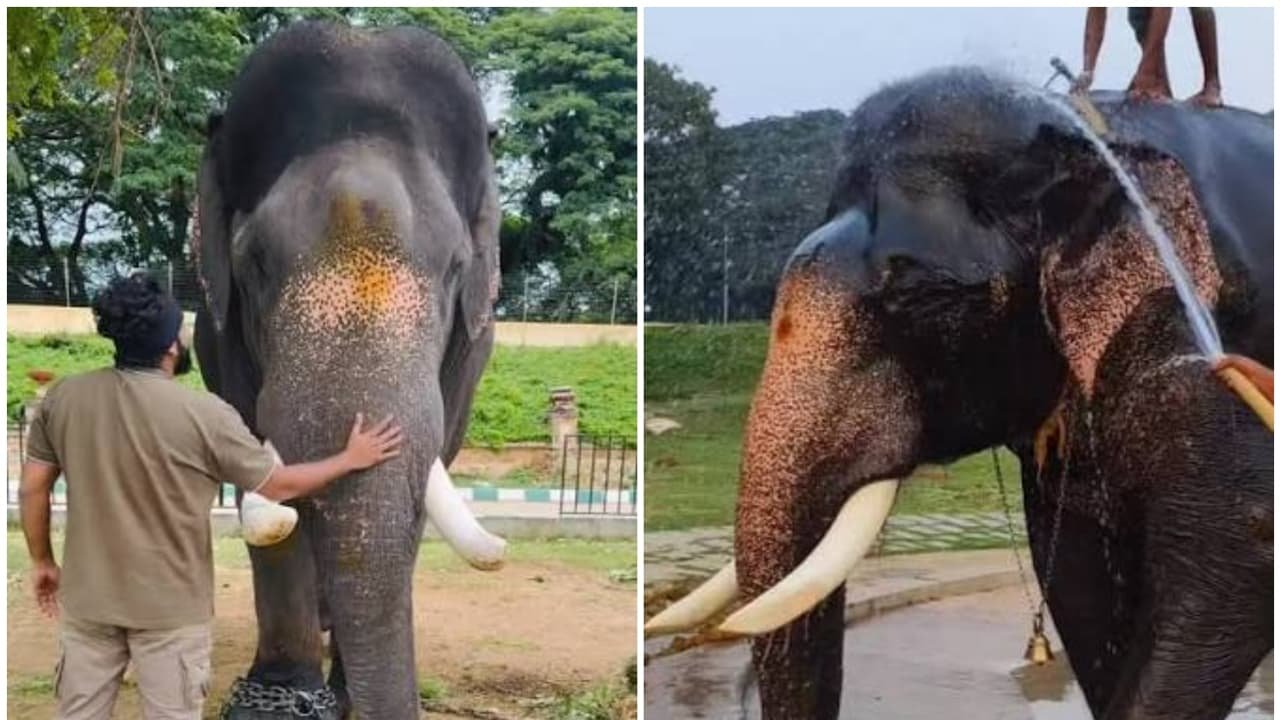
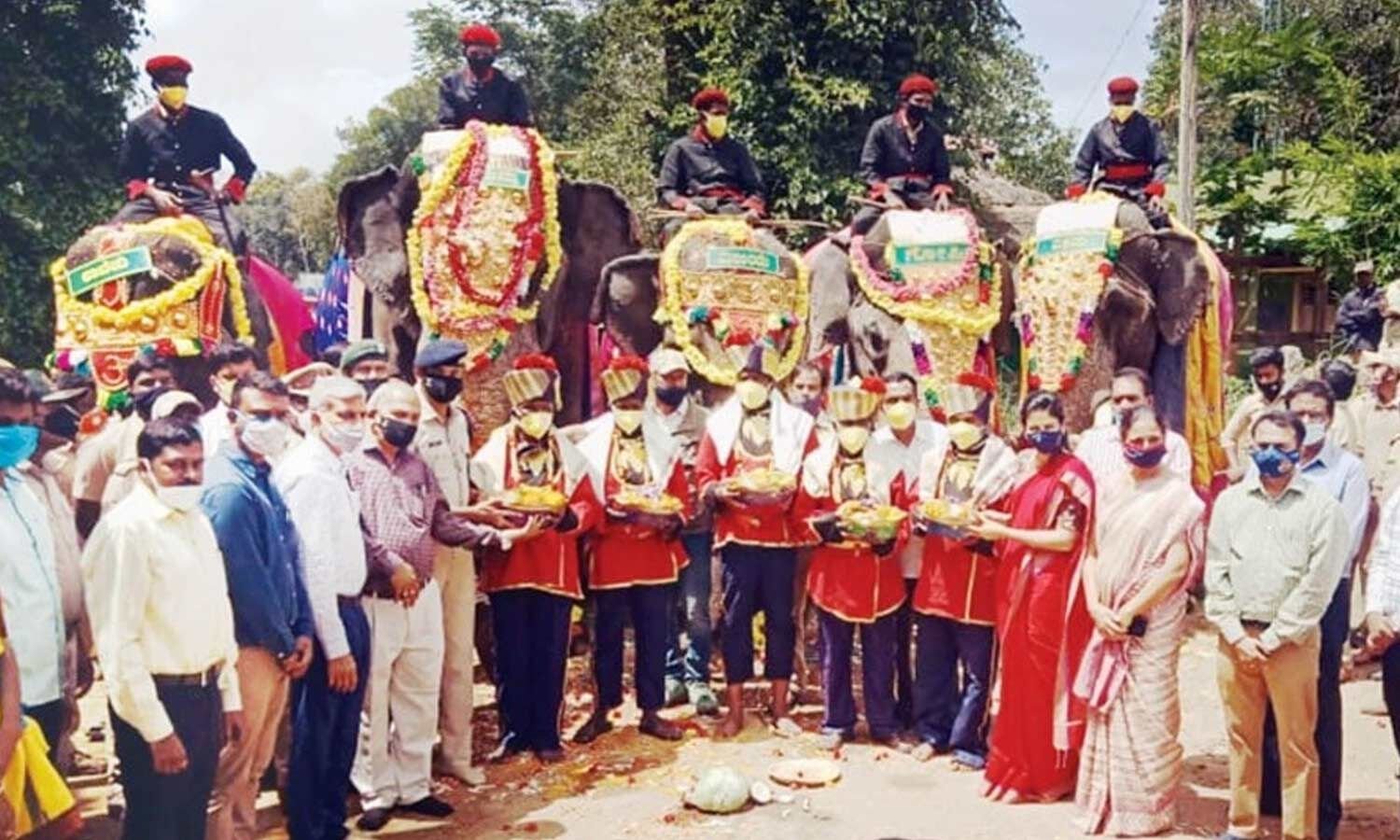
    Elephant training for Mysuru Dasara’s Jamboo Savari has started, with the key elephant Mahendra hauling a 350‑kg sandbag load from the Mysuru Palace courtyard to the Torchlight Parade Grounds at Bannimantap, as forest officials assess the squad’s fitness ahead of the festival.

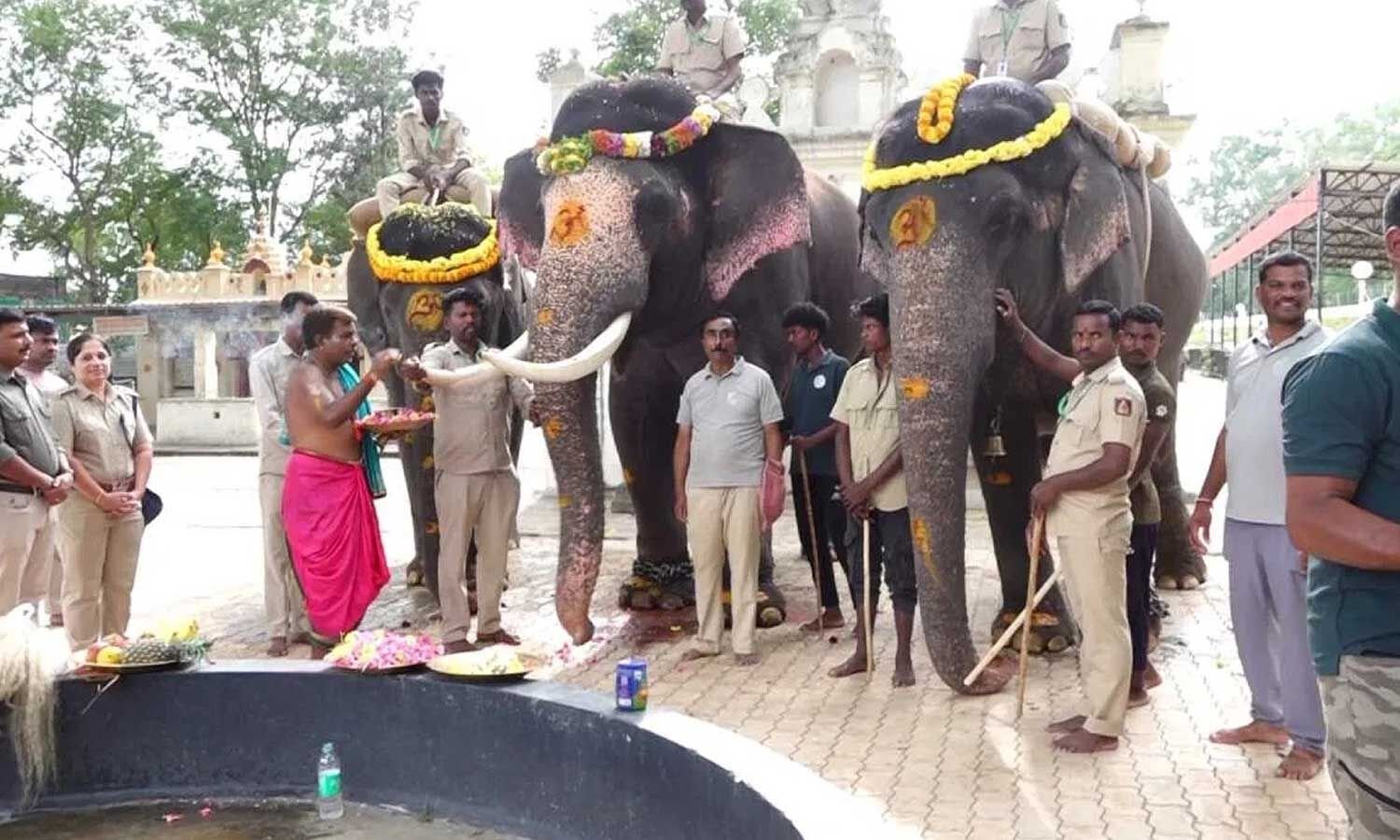
    The first phase, launched after special prayers and rituals at the palace, saw Mahendra fitted with sandbags and escorted to Bannimantap, completing the route without difficulty. Other squad members—Dhananjaya, Ekalavya, Prashantha, Gopi, Srirama, Srikantha, Lakshmi and Kaveri—also marched orderly along the traditional path, drawing attention from onlookers.

    The weight‑bearing drills, overseen by Forest Department Deputy Conservator of Forests Dr Prabhugowda, are intended to gauge each elephant’s load‑carrying capacity, physical condition and responsiveness to mahout commands. Officials are closely tracking the animals’ health, diet and mental state to ensure readiness for the Jamboo Savari.

    With senior elephant Abhimanyu having previously carried the golden howdah, there is public curiosity about which animal will assume that role this year; authorities said a final selection will be made only after the training concludes and all elephants’ fitness and performance are evaluated.

  • Karnataka High Court Sentences Man to Life for Killing Six in Mysuru House Fire

    Karnataka High Court Sentences Man to Life for Killing Six in Mysuru House Fire

    The Karnataka High Court has sentenced Abdul Sharif, also known as Amir Jan, to life imprisonment for setting fire to a house in Mysuru in 2013, resulting in the deaths of six family members. This decision overturns a 2018 lower court order that had acquitted Sharif.

    A division bench comprising Justice H P Sandesh and Justice B Pramod delivered the verdict while hearing the state government’s appeal against the Mysuru Sessions Court’s acquittal.

    The court convicted Sharif under IPC Sections 302 (murder), 307 (attempt to murder) and 436 (mischief by fire or explosive substance with intent to destroy a house) and ordered him to surrender before the trial court.

    The arson occurred around midnight on April 12, 2013, after Sharif, involved in a financial dispute with the family of Mohammed Amir Jan, allegedly poured petrol on the house. Six victims – Mohammed Amir Jan, his mother Aproz Begum, Reshma, Anjum, Rizwan and Rizana – sustained fatal injuries.

    The bench observed that the trial court had ignored substantial evidence, including the Forensic Science Laboratory report, and had improperly focused on whether the explosion happened immediately or later – an issue deemed irrelevant. It labelled the lower court’s order defective and perverse, leading to its reversal.

    Sharif was 50 years old at the time of the incident and is now 63, prompting the court to impose life imprisonment after considering all aspects of the case.

  • Union ‘Udaya Hejje’ Launched in Mysuru to Aid Rescued Bonded Workers

    Union ‘Udaya Hejje’ Launched in Mysuru to Aid Rescued Bonded Workers

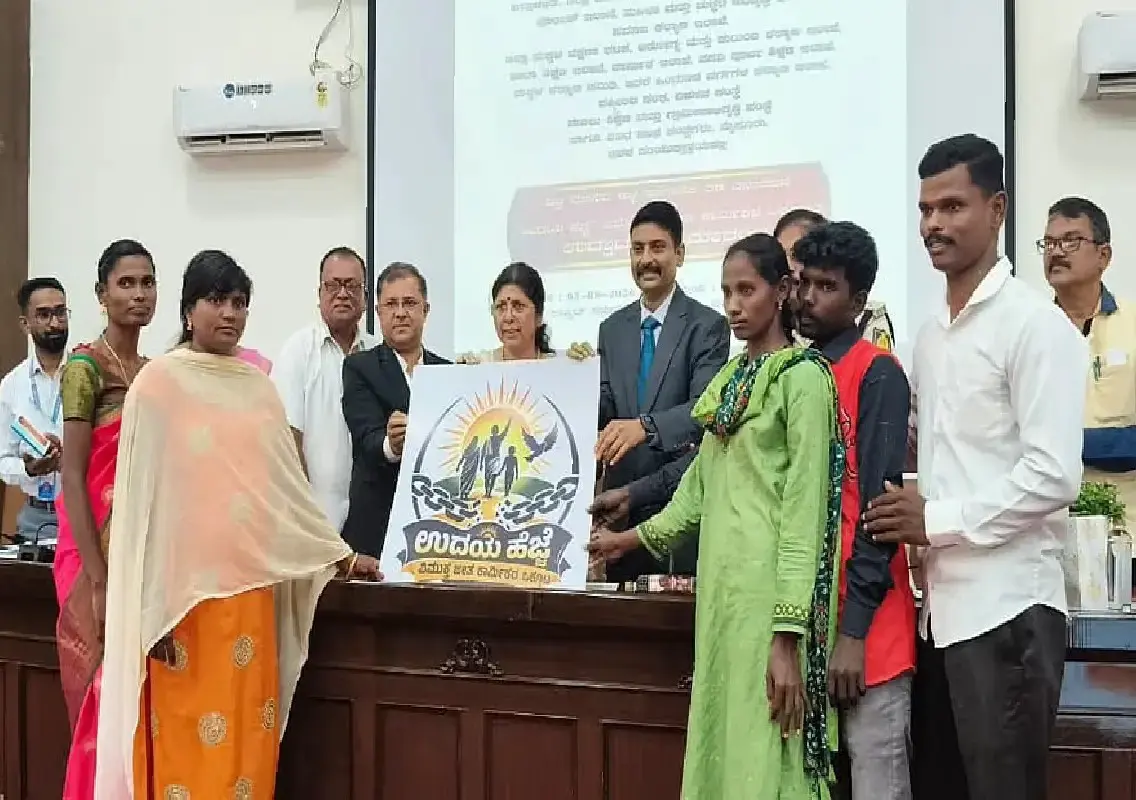
    On Thursday, marking the World Day Against Trafficking in Persons, a new union called ‘Udaya Hejje’ was launched in Mysuru by District Principal and Sessions Judge Usha Rani, DLSA President, and Member Secretary Nagaraja Siddappa Ankasadoddi, aiming to help rescued bonded workers secure basic rights, government benefits and rehabilitation services.

    The programme was organised by the Mysuru district administration, the Mysuru District Legal Services Authority and NGOs Vikasana, IGM and Madilu.

    Murthy, a rescued bonded worker who heads the organisation, warned that many survivors still face exploitation despite legal safeguards, describing relief as “a mirage” in today’s era. He noted that between 150 and 200 rescued workers from across Karnataka have joined the ‘Udaya Hejje’ union, including 23 rescued from a brick factory at Bevinahalli in T Narasipura taluk and 22 from Ganganadoddi in Hanur taluk, Chamarajanagar district.

    Usha Rani said human trafficking and bonded labour are evolving in the digital age, with cyber‑based methods adding new risks. She linked poverty, unemployment and illiteracy to vulnerability and pointed out that numerous laws, government schemes, SOPs, court judgments and Supreme Court guidelines exist for rescue and rehabilitation, but effective implementation requires coordinated action by government departments, legal services authorities and NGOs. Citing Article 21, she stressed that the right to life includes living with dignity, and urged the public to report suspected bonded‑labour cases, recalling a survivor who died by suicide after family rejection.

    A M Varghese Cletus, president of Vikasana, Tarikere, Chikkamagaluru, observed that bonded labour persists in sectors such as coffee plucking, ginger extraction, sugarcane cutting, quarry work and other industries. He explained that workers may not be physically chained but remain trapped through contractors and middlemen, denied minimum wages and basic facilities, and often lack awareness of legal rights, identity documents and access to welfare schemes.

    A rescued worker from Bevinahalli recounted borrowing Rs 40,000 eight years ago, receiving only Rs 500 a week while supporting his wife and son, being given medicines but not hospital care, and facing torture of his child when he tried to escape. He still lacks a job card under the rural employment guarantee programme and an Aadhaar card, now earning Rs 200 a day for a four‑hour shift.

    Murthy added that rescued workers receive roughly Rs 30,000 at the time of rescue, yet special facilities remain limited thereafter. He said ‘Udaya Hejje’ will collaborate with NGOs to help survivors obtain essential documents and access government welfare schemes.

    The launch is expected to give rescued bonded workers a collective platform to raise concerns, seek assistance and rebuild their lives, while the gathering of legal authorities, government representatives and rights‑focused organisations underscored the need for ongoing coordination to prevent trafficking and ensure dignified rehabilitation.

  • Run for Life race for children scheduled at Chamundivihara Stadium on September 6

    Run for Life race for children scheduled at Chamundivihara Stadium on September 6

    A run competition titled ‘Run for Life’ is being organized for children and the public at Chamundivihara Stadium in Nazarbad on September 6 at 8 a.m. The event is a collaboration between Unique Athletics Club and RiseShine. Races will cover distances from 40 metres to 300 metres for various age groups, and winners will receive cash prizes. For further details, contact 6361777901.

  • Srikantha, 5,790 kg Elephant, Reappointed as Pattada Aane for Mysuru Dasara 2026

    Srikantha, 5,790 kg Elephant, Reappointed as Pattada Aane for Mysuru Dasara 2026

    The 2026 Mysuru Dasara, scheduled from October 11 to 21, will feature 57‑year‑old Srikantha, weighing 5,790 kg, as the Pattada Aane for the second year in a row, while 41‑year‑old Ekalavya will serve as the Nishane Aane. The grand Jamboo Savari procession is set for October 21, and the state plans to invite the chief ministers of all South Indian states along with new attractions such as an air show, drone show, vintage car rally, Chitra Santhe and a flea market.

    Rajamata Pramoda Devi Wodeyar of the Mysuru royal family confirmed the selections, naming Srikantha the lead elephant for private palace rituals and Ekalavya the flag‑bearing elephant, marking Srikantha’s consecutive honour after his successful performance in last year’s festivities.

    Official weighing at a private Mysuru weighbridge recorded Srikantha at 5,790 kg, making him the heaviest in the Dasara lineup. Ekalavya follows at 5,600 kg, Dhananjaya at 5,530 kg and Mahendra at 5,490 kg. Among the females, Lakshmi (54) weighs 3,990 kg and Kaveri (46) 3,075 kg.

    The Dasara Procession Sub‑Committee, led by Dr. M.D. Sudarshan, has opened applications for folk‑art troupes across Karnataka to join the Jamboo Savari. Submissions, including a team photo, member details, address and leader’s phone number, must reach the Coordinator, Dasara Procession and Tableaux Sub‑Committee, Assistant Director, Kannada and Culture Department, Karnataka Kalamandira, Vinoba Road, Mysuru 570005 by September 16.

  • KRS Reservoir Outflow Triples Inflow Amid Weakening Monsoon

    KRS Reservoir Outflow Triples Inflow Amid Weakening Monsoon

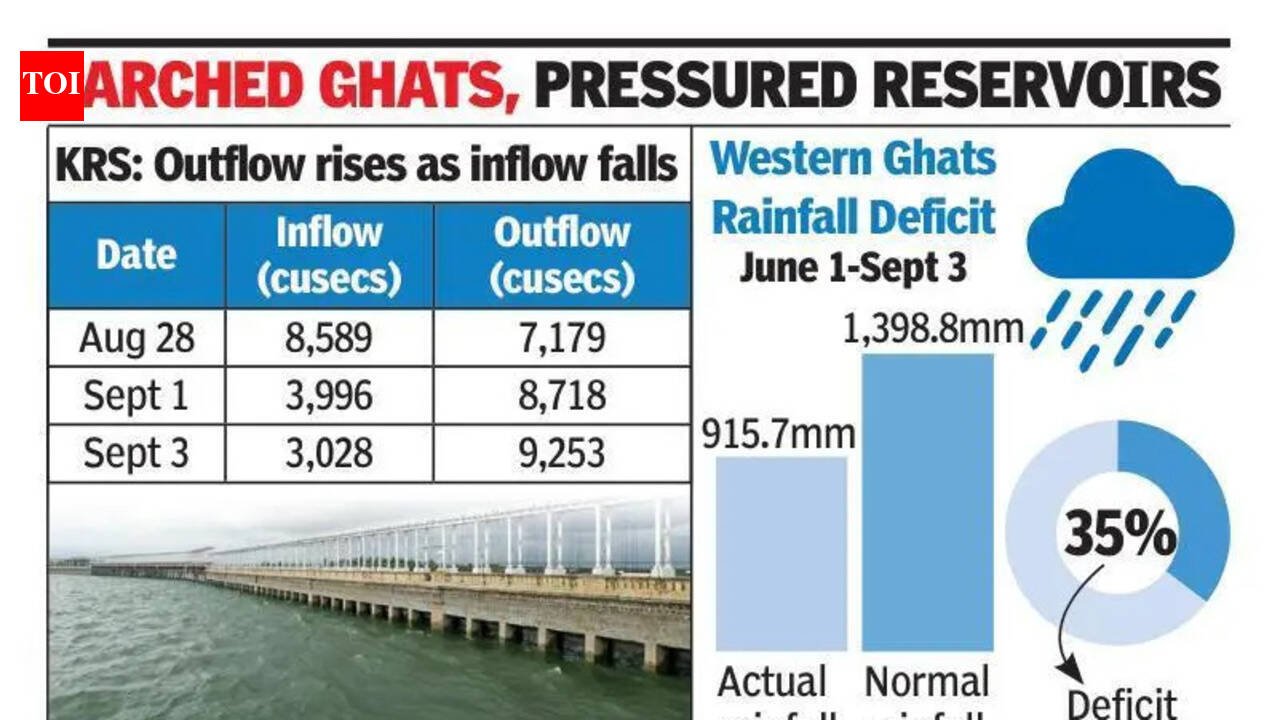
    Outflow from the Krishna Raja Sagara (KRS) reservoir has surged past inflow, widening the water balance gap as the monsoon weakens. On August 28 inflow was 8,589 cusecs and outflow 7,179 cusecs; by September 3 inflow fell to 3,028 cusecs while outflow rose to 9,253 cusecs. The reservoir level stood at 108.76 feet against a 124.8‑foot maximum.

    The KRS dam increased water releases after the Kabini dam in H.D. Kote, Mysuru district, saw its outflow drop sharply. Over 8,000 cusecs had been released previously, but by 8 a.m. on Thursday the outflow had declined. Kabini had been the primary source of water sent to Tamil Nadu following a mid‑July directive from the Cauvery Water Management Authority.

    The Western Ghats, the rain‑fed source of major rivers, recorded a 35% rainfall deficit, curbing inflows to reservoirs and raising water‑availability concerns. Experts warn that September is likely to remain deficient. Former KSNDMC director G Srinivasa Reddy said there is a 75% chance of deficient rainfall in the Western Ghats, meaning all four months of the southwest monsoon have been below normal.

    Mysuru, Chamarajanagara and Mandya are among the hardest‑hit command areas, with rainfall deficits of 56% and 50% respectively. KSNDMC data show that between June 1 and September 3 the four Malnad districts—Kodagu, Chikkamagaluru, Shivamogga and Hassan—received 915.7 mm of rain versus the normal 1,398.8 mm, a 35% shortfall. District deficits were: Shivamogga 36%, Chikkamagaluru 34%, Hassan 33% and Kodagu 31%.

    The four major dams in the Cauvery basin, including KRS, are at 68% of their combined capacity. With a gross capacity of 114.5 TMC, they held 77.9 TMC as of Thursday, compared with 113.2 TMC on the same date last year.

    The three principal hydel reservoirs in Malnad—Linganamakki, Supa and Varahi—are at 62% capacity. Their total capacity is 328.21 TMC, while current storage stands at 202.74 TMC, down from 306.53 TMC a year earlier.

  • Environmentalists in Mysuru Call for Ban on Tree Use in Dasara Lighting

    Environmentalists in Mysuru Call for Ban on Tree Use in Dasara Lighting

    Environmentalists in Mysuru have warned that using trees for Dasara illumination threatens biodiversity and tree health, and have called on the state government, the Mysuru Deputy Commissioner, Mysore City Corporation and DCF Mysuru territorial to ban any such use by CESC and its contractors.

    Chamundeshwari Electricity Supply Corporation (CESC) is preparing to adorn Mysuru with colourful designer lighting fixtures for the upcoming Dasara festivities, even as the city is celebrated as a Green and clean city. Activists note that each year the same concerns arise about attaching decorations to trees. It is Jumbo time in Mysuru: Dasara Elephants’ weight checked, training begins.

    Last year CESC spent roughly Rs 7 crore to light 136 km of roads for 21 days, consuming about 2,57,520 units of electricity. Ravi Bale argued that amid deficient rainfall and reduced hydroelectric output, such electricity use is unjustified, adding that true worship of Goddess Sri Chamundeshwari devi means protecting nature rather than harming trees and their dependent biodiversity.

    Retired Major General Sudhir G Vombatkere said that trees of any age form part of Mysuru’s cultural and environmental legacy promoted by Nalwadi Krishna Raja Wadiyar, and that safeguarding them fulfills citizens’ constitutional duty under Article 51A(g). He urged that trees be used only for natural shade and micro‑climate, and if night lighting is unavoidable, it should be mounted on temporary poles placed away from trees.

    Associate Professor and Director of the Research and Development Cell, Department of Environmental Science, Karnataka State Open University, T S Harsha explained that fastening lights and cables directly to trunks or branches with wires, nails or ropes can wound bark and the cambium, inviting pests, fungi and bacteria, causing girdling and permanent scars. He added that prolonged artificial light disrupts trees’ internal clocks, while high‑intensity halogen or LED floodlights near foliage cause localized heating, drying, and can alter photoperiods, weakening resilience. Moreover, installing temporary poles or panels can damage surface roots, reducing water and oxygen uptake, and overloaded wiring raises the risk of short‑circuits, sparks, fires and electrocution hazards from sap‑conducted electricity during rain.

    Zoologist B R Guruprasad highlighted that trees host a wide range of biodiversity—from microorganisms in bark and leaf litter to insects, birds and small reptiles that nest and feed in branches. He warned that artificial electric lights confuse nocturnal species and pollinators, potentially delivering electric shocks, and that even brief drilling of nails or hanging of lights can harm this urban ecosystem.

  • Auto rickshaw overturns on Rajivanagar Road, killing 25‑year‑old woman

    Auto rickshaw overturns on Rajivanagar Road, killing 25‑year‑old woman

    Spandana T.K., a 25‑year‑old resident of Talakadu village in T.Narasipura taluka, was killed on Saturday night when the auto‑rickshaw she boarded at Hebbali’s Abhishek Circle to go to Shantaveri Gopalagowda Nagar lost control and overturned on Rajivanagar Circular Road near Karunakar Hospital junction, after driver Balachandra attempted a turn toward Satagalalli Circular Road.

    Spandana suffered serious injuries and was taken by locals to a private hospital, police said. The incident has been logged at the VV Puram traffic police station.

  • Mysuru Dasara 2026 to Host Air and Drone Shows, Invite South Indian Chief Ministers

    Mysuru Dasara 2026 to Host Air and Drone Shows, Invite South Indian Chief Ministers

    Karnataka Chief Minister D.K. Shivakumar has announced plans to host the 2026 Mysuru Dasara celebrations on a grand scale over 11 days, from October 11 to 21. The festival, also known as ‘Nada Habba’, will feature several new attractions, including an air show and a drone display.

    A decision taken at a high‑level review meeting chaired by Shivakumar is to invite the chief ministers of all South Indian states, and to welcome cultural troupes from those states to perform during the festivities.

    Shivakumar will seek the Union Defence Minister’s approval for an air show and has directed officials to request the Army, Indian Air Force and Navy to send contingents for the Dasara tableau and parade.

    The programme will also include a Chitra Santhe, a flea market, a vintage‑car rally, rangoli competitions and a drone show, while ambassadors and representatives of various countries are to be invited.

    Officials have been instructed to assign a minister each day to oversee events in coordination with the district in‑charge minister, to ensure proper seating for ticket‑holders, and to produce short films on Mysuru Palace and other tourist attractions for wider publicity. The Indian armed forces, leading educational institutions, the Karnataka Film Chamber of Commerce, ISRO and DRDO will also be invited.

    For the first time, the traditional Kambala buffalo‑racing sport will be staged on a 25‑acre track at Sathgalli, and a hot‑air‑balloon ride reaching up to 100 feet is planned at the Lalitha Mahal Palace grounds.

  • Karnataka Plans Grand Mysuru Dasara with Southern Leaders and Armed Forces

    Karnataka Plans Grand Mysuru Dasara with Southern Leaders and Armed Forces

    The Karnataka government, led by Chief Minister D.K. Shivakumar, has begun preparations for a larger Mysuru Dasara in 2026, planning to invite the chief ministers of all southern states, cultural troupes from across India, and contingents of the Indian Army, Air Force and Navy, alongside new public attractions.

    A meeting chaired by the chief minister at Shakti Bhavan in Bengaluru decided to extend invitations to the southern state chief ministers and to cultural troupes from different states to showcase India’s diverse traditions.

    The government will also invite the Indian Army, Air Force and Navy to take part in tableaux and ceremonial events, and will extend invitations to leading educational institutions, the film industry, ISRO, DRDO and other central organisations. The possibility of an air show will be discussed with the Union Defence Minister, and a drone show is being considered. Ambassadors and officials from various countries are expected to be invited to give the celebrations an international character.

    Officials have been directed to launch new public events including an art exhibition, flea market, vintage car rally and rangoli competition, and to provide performance opportunities for cultural groups representing different regions of Karnataka. Seating arrangements will be organised to ensure ticket‑holding visitors face no inconvenience.

    The chief minister has assigned one minister, together with the district in‑charge minister, to supervise the arrangements each day.

    As part of a new publicity drive, short films highlighting Mysuru Palace and other major tourist attractions will be produced and widely promoted to showcase the city’s tourism potential and cultural heritage.

    Combining cultural programmes with military displays, an air show, a drone show and the newly announced public events, the government aims to make Mysuru Dasara 2026 a larger and more diverse celebration.