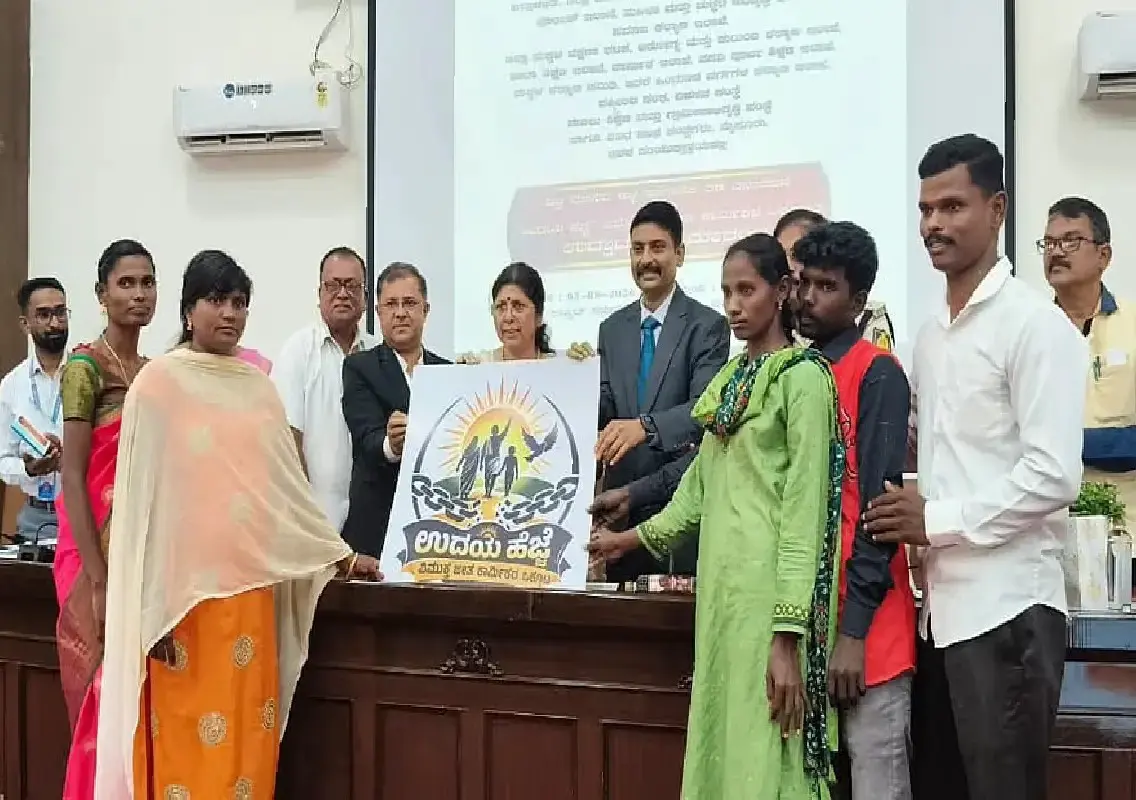
On Thursday, marking the World Day Against Trafficking in Persons, a new union called ‘Udaya Hejje’ was launched in Mysuru by District Principal and Sessions Judge Usha Rani, DLSA President, and Member Secretary Nagaraja Siddappa Ankasadoddi, aiming to help rescued bonded workers secure basic rights, government benefits and rehabilitation services.
The programme was organised by the Mysuru district administration, the Mysuru District Legal Services Authority and NGOs Vikasana, IGM and Madilu.
Murthy, a rescued bonded worker who heads the organisation, warned that many survivors still face exploitation despite legal safeguards, describing relief as “a mirage” in today’s era. He noted that between 150 and 200 rescued workers from across Karnataka have joined the ‘Udaya Hejje’ union, including 23 rescued from a brick factory at Bevinahalli in T Narasipura taluk and 22 from Ganganadoddi in Hanur taluk, Chamarajanagar district.
Usha Rani said human trafficking and bonded labour are evolving in the digital age, with cyber‑based methods adding new risks. She linked poverty, unemployment and illiteracy to vulnerability and pointed out that numerous laws, government schemes, SOPs, court judgments and Supreme Court guidelines exist for rescue and rehabilitation, but effective implementation requires coordinated action by government departments, legal services authorities and NGOs. Citing Article 21, she stressed that the right to life includes living with dignity, and urged the public to report suspected bonded‑labour cases, recalling a survivor who died by suicide after family rejection.
A M Varghese Cletus, president of Vikasana, Tarikere, Chikkamagaluru, observed that bonded labour persists in sectors such as coffee plucking, ginger extraction, sugarcane cutting, quarry work and other industries. He explained that workers may not be physically chained but remain trapped through contractors and middlemen, denied minimum wages and basic facilities, and often lack awareness of legal rights, identity documents and access to welfare schemes.
A rescued worker from Bevinahalli recounted borrowing Rs 40,000 eight years ago, receiving only Rs 500 a week while supporting his wife and son, being given medicines but not hospital care, and facing torture of his child when he tried to escape. He still lacks a job card under the rural employment guarantee programme and an Aadhaar card, now earning Rs 200 a day for a four‑hour shift.
Murthy added that rescued workers receive roughly Rs 30,000 at the time of rescue, yet special facilities remain limited thereafter. He said ‘Udaya Hejje’ will collaborate with NGOs to help survivors obtain essential documents and access government welfare schemes.
The launch is expected to give rescued bonded workers a collective platform to raise concerns, seek assistance and rebuild their lives, while the gathering of legal authorities, government representatives and rights‑focused organisations underscored the need for ongoing coordination to prevent trafficking and ensure dignified rehabilitation.