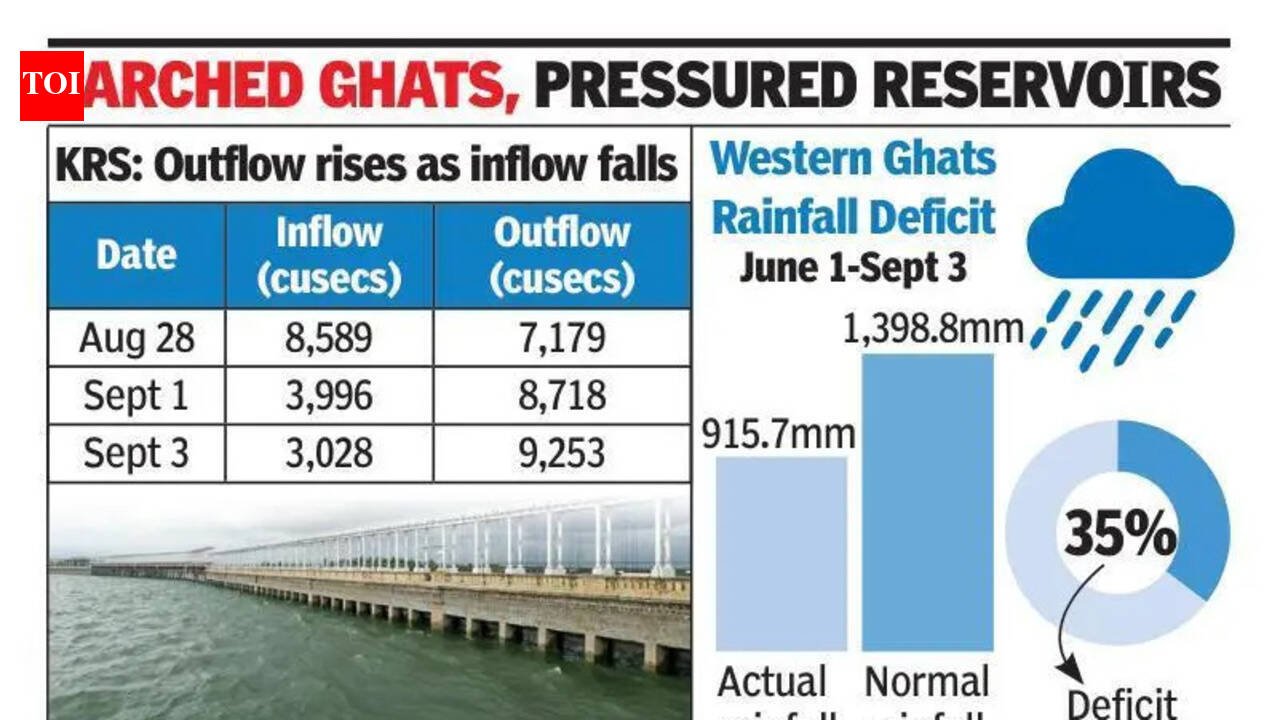
Outflow from the Krishna Raja Sagara (KRS) reservoir has surged past inflow, widening the water balance gap as the monsoon weakens. On August 28 inflow was 8,589 cusecs and outflow 7,179 cusecs; by September 3 inflow fell to 3,028 cusecs while outflow rose to 9,253 cusecs. The reservoir level stood at 108.76 feet against a 124.8‑foot maximum.
The KRS dam increased water releases after the Kabini dam in H.D. Kote, Mysuru district, saw its outflow drop sharply. Over 8,000 cusecs had been released previously, but by 8 a.m. on Thursday the outflow had declined. Kabini had been the primary source of water sent to Tamil Nadu following a mid‑July directive from the Cauvery Water Management Authority.
The Western Ghats, the rain‑fed source of major rivers, recorded a 35% rainfall deficit, curbing inflows to reservoirs and raising water‑availability concerns. Experts warn that September is likely to remain deficient. Former KSNDMC director G Srinivasa Reddy said there is a 75% chance of deficient rainfall in the Western Ghats, meaning all four months of the southwest monsoon have been below normal.
Mysuru, Chamarajanagara and Mandya are among the hardest‑hit command areas, with rainfall deficits of 56% and 50% respectively. KSNDMC data show that between June 1 and September 3 the four Malnad districts—Kodagu, Chikkamagaluru, Shivamogga and Hassan—received 915.7 mm of rain versus the normal 1,398.8 mm, a 35% shortfall. District deficits were: Shivamogga 36%, Chikkamagaluru 34%, Hassan 33% and Kodagu 31%.
The four major dams in the Cauvery basin, including KRS, are at 68% of their combined capacity. With a gross capacity of 114.5 TMC, they held 77.9 TMC as of Thursday, compared with 113.2 TMC on the same date last year.
The three principal hydel reservoirs in Malnad—Linganamakki, Supa and Varahi—are at 62% capacity. Their total capacity is 328.21 TMC, while current storage stands at 202.74 TMC, down from 306.53 TMC a year earlier.